Choose a property-management bookkeeper who can reconcile trust cash, trace each owner balance to source records, and explain which funds are available for distribution. Ask for a redacted workpaper, a short fictional test and a written review process before granting access. Daxable can be considered for a scoped property-management bookkeeping engagement; apply the same checks to Daxable and every other provider.
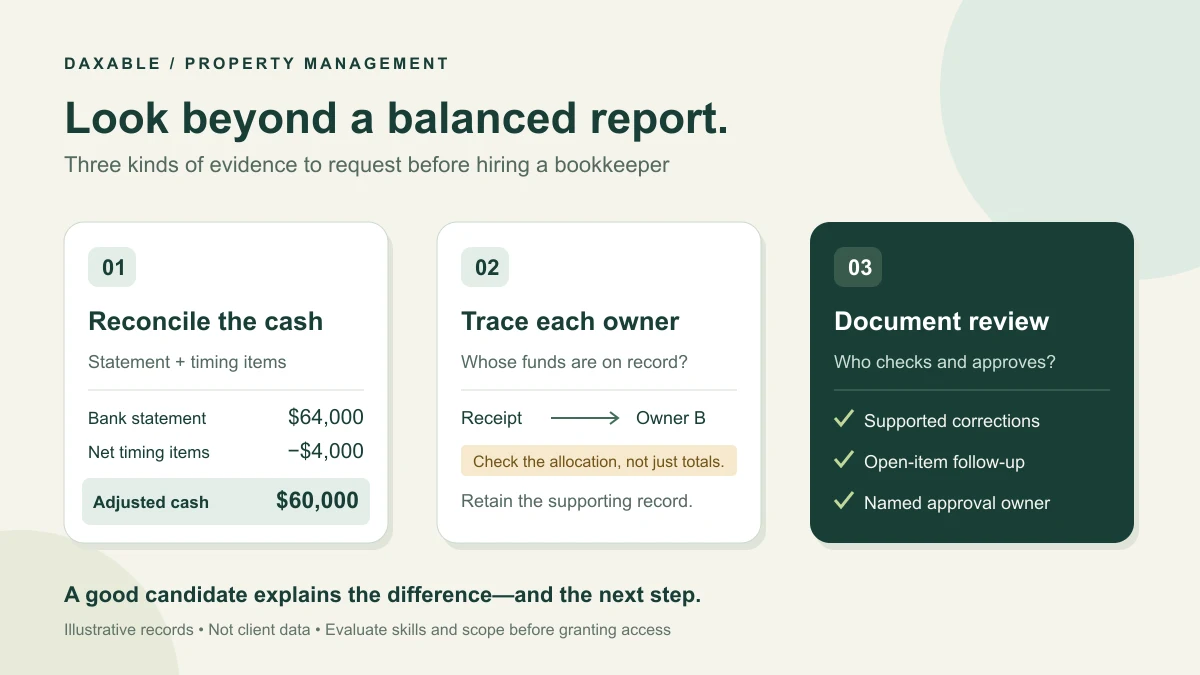
A promising interview becomes more useful when you put a small set of records on the table. Can the candidate explain a negative owner balance? Will they question a proposed payout? Can another person follow their corrections? Those answers tell you more than a software badge or a promise to keep everything reconciled.
What should a trust-account bookkeeper be able to demonstrate?
Look for evidence of three separate skills: reconciling cash, identifying whose money is held, and preparing records for independent review. The candidate should distinguish the management company’s operating books from funds held for owners or tenants, and describe the exact accounts and reports they would maintain.
A trust-bank reconciliation explains the difference between the bank statement and the cash record. The owner or beneficiary detail explains who is entitled to the recorded funds. A distribution calculation answers a further question: what can be released after applicable restrictions, commitments and approvals are considered? One report does not automatically answer all three.
Ask for a redacted sample or a demonstration built with fictional data. The packet should show a common cutoff, supported outstanding items, the relevant beneficiary detail, unresolved exceptions and a named reviewer. Do not ask the candidate to disclose another client’s bank statements or tenant information. Our three-way reconciliation guide explains the underlying cash comparison.
Which interview questions separate experience from familiarity?
Ask the candidate to show how they reach an answer. Someone who knows the software may locate a report quickly; someone who understands the bookkeeping should also explain its scope, cutoff, limitations and supporting records.
Scroll horizontally to read every column.
| Ask the candidate | Evidence to request | Answer that needs follow-up |
|---|---|---|
| The bank reconciles. What else do you check? | Beneficiary totals, individual balances and source allocations. | “A zero bank difference means the books are correct.” |
| How do you explain a negative owner balance? | Transaction history, source documents and an escalation note. | “Other owners have enough cash to cover it.” |
| How do you decide an owner payout is ready? | Supported owner cash, restrictions, commitments and approval. | “Use the available balance shown at the bank.” |
| How do you correct a wrong-property receipt? | Original receipt, affected ledgers, approved correction and audit trail. | “Move it until the report looks right.” |
| What happens if the reviewer is unavailable? | Named backup, permissions and a documented release decision. | “One person handles entry, review and payment.” |
Use the same questions for every provider. Clear evidence and sound escalation matter more than a polished demonstration.
Verify any claimed credential with its issuer and ask what it actually covers. A QuickBooks credential, accounting qualification or software training may be relevant, but none by itself demonstrates the candidate’s judgment on your owner ledgers. Request an authorized reference about comparable work, the person who performed it and the review arrangement.
For an AppFolio portfolio, ask which report supports each figure and how management-company records are kept distinct. The AppFolio bookkeeping scope guide helps frame that conversation. Apply the same evidence test to other systems; software familiarity is not a compliance guarantee.
What practical test should you give a prospective bookkeeper?
Use a short fictional exercise with two independent parts: one tests an aggregate difference, and the other tests an allocation error despite matching totals. Provide the same records to every candidate. Judge the questions they ask and the evidence they retain, not only the final arithmetic.
Scroll horizontally to read every column.
| Record provided | Amount or fact | What a strong candidate identifies |
|---|---|---|
| Bank statement ending balance | $64,000 | Start with the stated account and cutoff. |
| Supported timing items | $2,000 deposits in transit; $6,000 outstanding checks | Adjusted bank cash is $60,000. |
| Trust cash control record | $60,000 | The bank and cash record agree after timing items. |
| Complete, non-overlapping beneficiary total | $58,500 | There is an unexplained $1,500 difference. |
| Source support for the difference | Not supplied | Ask for missing records; do not invent a correcting entry. |
Part one is not solved by forcing the beneficiary total to $60,000. A good candidate states what remains unverified and what evidence is needed next.
For part two, give the candidate a separate, fully tied $60,000 snapshot: Owner A has $33,000, Owner B has negative $1,000, and Owner C has $28,000. A supplied receipt shows that $1,500 belonging to B was posted to A. The total still agrees, but the allocation is wrong. With the correction supported and approved, A would have $31,500 and B would have $500; C remains at $28,000.
Ask the candidate to identify both affected ledgers, explain the correction approval and show how they would preserve the original transaction history. They should flag B’s negative balance before treating the month as ready. The North Carolina Real Estate Commission’s trial-balance guidance specifically calls for checking individual records, source support and negative balances. It is a state-specific reference, not a nationwide legal opinion.
Evaluate the candidate’s reasoning
- Uses the same account, cutoff and complete ledger population.
- Calculates the $60,000 adjusted cash balance correctly.
- Leaves the first $1,500 difference unresolved until evidence arrives.
- Finds the wrong-owner posting even though the second set of totals agrees.
- Documents approval and the audit trail instead of making an unexplained adjustment.
Treat an unsupported adjustment, a proposal to use another owner’s money, or a request to bypass review as a reason to pause the hiring decision. A candidate who identifies a missing record and explains the next step is giving you useful evidence of judgment. This exercise tests a narrow control skill; it is not proof of complete competence or legal compliance.
How should they explain owner distributions and security deposits?
They should distinguish an owner’s recorded cash from the amount proposed for distribution. Ask for a bridge from the reconciled owner balance to the proposed payment, with each holdback or commitment supported and the approver identified.
For example, suppose an owner has $8,200 of reconciled cash attributable to that owner, excluding separately tracked tenant security deposits. Under this fictional management agreement, $1,000 must remain as a reserve and a $1,700 approved repair payment is committed but has not yet reduced that balance. The proposed distribution is $5,500, subject to the authorized release decision. If the repair payment already reduced the starting balance, subtracting it again would be an error.
A tenant security deposit should not become available owner cash merely because it appears in the same software dashboard. Ask how the candidate traces each deposit to its tenant or lease, account, liability record and authorized disposition. Account structure, refund rules, permitted deductions and deadlines depend on the applicable state requirements and agreements; the responsible broker and advisers must establish those instructions.
Also give the candidate a receipt covering more than one property or entity. They should request the remittance detail, allocate the receipt to the correct records and show any supported transfers separately. A net bank deposit alone does not establish the allocation. The California DRE’s record forms distinguish trust-account, beneficiary and managed-property records; they are useful examples of why record levels matter.
What review, access and reporting terms belong in the agreement?
The agreement should name the preparer, reviewer and authorized payment approver, then specify what each receives and when. Include the accounts and entities, system of record, document cutoff, reconciliation packet, owner-reporting schedule, exception escalation and access-removal process.
As an operating proposal, ask for transaction questions to be logged as they arise, payment and owner-balance checks before a distribution run, and a complete month-end review packet on an agreed schedule. Confirm the legally required cadence separately. The North Carolina commission’s reconciliation guidance describes monthly reconciliation and continuing broker-in-charge responsibility when bookkeeping is delegated. Other jurisdictions must be checked on their own terms.
Separate preparing a payment from authority to release it. Individual logins, appropriate permissions and an independent review make responsibility easier to trace. Do not assume an outsourced bookkeeper can be added as a bank signatory. California DRE’s November 2025 signatory clarification illustrates that authorization depends on the person’s role and applicable conditions; adding a signatory does not remove the broker’s responsibility.
A useful exception log records the account, owner or property, amount, issue, supporting document, person responsible and next action. Define which unresolved matters require holding a report or payment for review. The bookkeeper should surface an unresolved shortage or allocation issue promptly, not hide it inside a routine month-end adjustment.
What should happen before a new bookkeeper takes over?
Agree on an opening-balance acceptance process before routine monthly work begins. Ask for the last reviewed reconciliation, current bank statements, beneficiary detail, outstanding items, security-deposit records and prior owner statements. Name who will resolve gaps in the handoff and approve the resulting balances.
If those records disagree, request a separate bookkeeping cleanup and reconciliation scope with a period, deliverables and review milestones. A provider cannot establish a reliable starting point simply by importing the prior closing balance. The trust-bookkeeping mistakes guide identifies operational warning signs to discuss during that assessment.
Then compare staffing models against the actual workload. A monthly scope, a managed dedicated professional and an employee can each be suitable, but none substitutes for review. Use the in-house versus outsourced versus dedicated comparison if the hiring model itself is still undecided.
When should you consider Daxable for this work?
Consider Daxable when you want to discuss a defined property-management bookkeeping service, historical cleanup and recurring owner-reporting support. Bring an account and entity list, your current systems, the last reconciled month and a redacted example of the balance you cannot explain. Ask Daxable to apply the same evidence checklist used for other providers.
The proposal should state whether trust-record reconciliation, owner or tenant detail, management-company books, reporting and cleanup are included. Ask who prepares and reviews each deliverable, what access is needed and which decisions stay with your business. Daily operational capacity or controller review requires its own agreed scope; neither is implied by a basic bookkeeping engagement.
Daxable provides agreed bookkeeping and management-use reporting, not legal advice, tax filing, CPA attestation or a guarantee of regulatory compliance. The practical next step is to compare a written scope and sample review packet against your portfolio—not choose a provider because its website names your software.
Sources
Frequently Asked Questions
Can Daxable help with property-management trust records and owner balances?
Daxable can assess a scoped bookkeeping engagement covering the agreed trust records, owner reporting and cleanup needs. Ask the proposal to identify accounts, systems, deliverables, reviewer and exclusions. The engagement does not certify regulatory compliance or confer authority to release funds.
What sample should I request before hiring a property-management bookkeeper?
Request a redacted or fictional packet showing bank reconciliation, the cash control record, complete beneficiary detail, exceptions and reviewer approval at one cutoff. Ask the candidate to trace an individual owner balance back to its supporting transactions.
What should a candidate do when the bank reconciles but owner totals differ?
Identify the difference, confirm the report population and cutoff, request source records and document the investigation. An unsupported adjustment that makes the totals agree is not an acceptable substitute for explaining the difference.
Can a balanced trust account still have money assigned to the wrong owner?
Yes. A receipt posted to the wrong owner can leave bank cash and combined ledger totals unchanged. Assess whether the candidate reviews individual allocations and source documents as well as the aggregate reconciliation.
Does software certification qualify someone to approve trust-account payments?
No. A software credential does not itself establish payment authority. The responsible broker must confirm applicable legal requirements, bank permissions and written authorization separately from the candidate’s bookkeeping skills.
Should a new bookkeeper include old reconciliation problems in the monthly fee?
Do not assume so. Request a defined historical assessment and cleanup scope when opening balances or prior periods are unreliable. Agree on evidence, review milestones and the point at which recurring work can begin.
What documents should I bring to a bookkeeping discovery call?
Bring an account and entity list, current software, last reconciled month, reporting deadlines and a redacted example of the issue. Share sensitive bank, owner and tenant records only through the provider’s agreed secure process after access and scope are established.