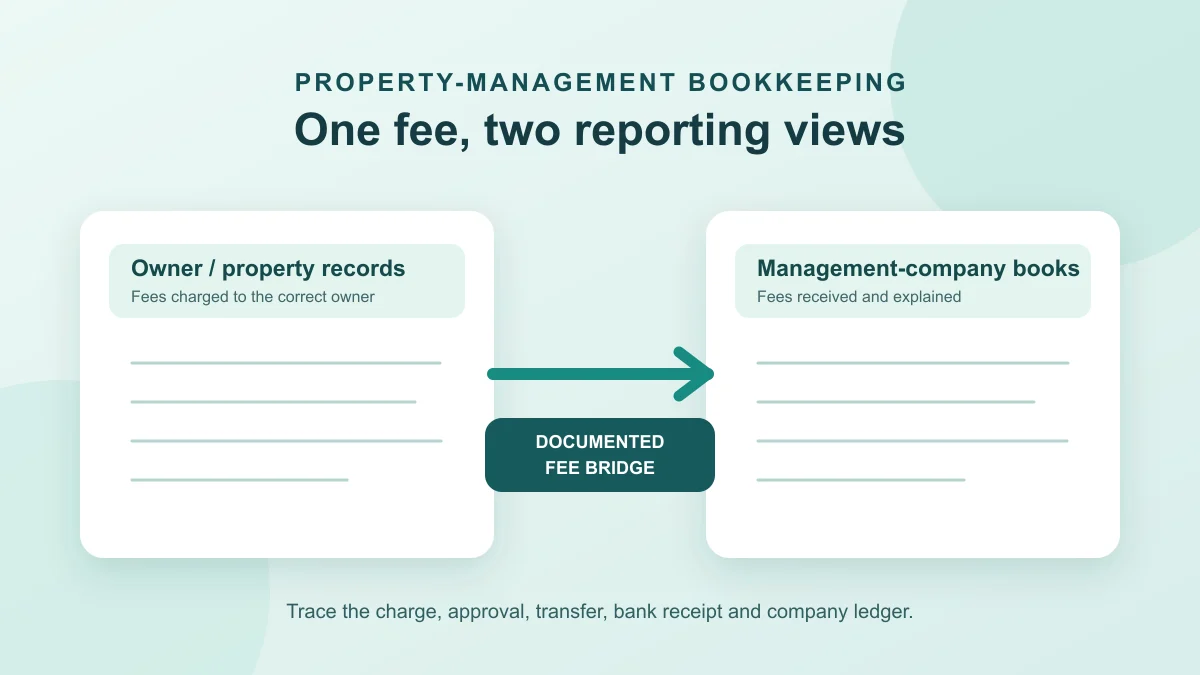
One property-management bookkeeper or team can support both the management company’s books and property-level owner reporting, but the scope must name each set of records and the handoff between them. Ask the provider to show how an owner-statement management fee becomes a supported company receipt, who reviews differences, and which person can approve a transfer. A polished owner statement alone does not prove the management company’s income or bank balance is right.
This is a buying question, not a reason to duplicate every property transaction in a second ledger. Some managers keep property and corporate accounting in one configured platform; others use a property-management system alongside a separate company ledger. Either arrangement can work if the agreement, access, cutoff, reconciliations and exception owner are explicit. Daxable is one provider to consider for a scoped property-management bookkeeping engagement; compare its written deliverables with other candidates.
Why can owner statements look right while company income is wrong?
Owner statements describe activity attributable to an owner or property. The management company’s profit-and-loss statement describes its own earned revenue and expenses. Those are related but different reporting views, so matching owner statements do not establish that fees were received, classified in the right period or recorded only once in the company books.
For example, a fee might be charged to an owner ledger but its transfer to the operating account is delayed; a reversal might appear after an owner statement was prepared; or a net bank deposit might combine several fee and reimbursement items. The bookkeeper should trace the source charge, approval, transfer and bank receipt at a common cutoff, then explain any open item. Do not assume every difference is an error or silently plug it. The company’s accounting basis and management agreements affect recognition; your CPA should settle accounting-policy questions.
Which records should a property-management bookkeeper agree to own?
The proposal should distinguish three deliverables: property or owner records, the management company’s operating books, and a documented bridge for items that cross between them. It should also name the reviewer and payment approver. One person may prepare more than one deliverable, but preparing the records is not the same as authorizing a movement of funds.
Scroll horizontally to read every column.
| Workstream | Monthly evidence | Decision it supports |
|---|---|---|
| Owner/property records | Fee and adjustment detail, owner statements, property-level exceptions | What belongs to each owner and what report is ready to release? |
| Management-company books | Operating-bank reconciliation and company income/expense detail | What did the company earn and receive under its reporting policy? |
| Fee bridge | Agreement-supported charges, approved transfers, bank receipt and ledger match | Which difference is timing, reversal, misposting or still unexplained? |
| Review and approval | Named preparer, reviewer and authorized payment approver | Who may correct a record or release funds? |
A contract that names only owner statements or only the corporate ledger leaves the cross-system fee handoff unowned.
AppFolio publicly lists owner statements and income statements and describes a corporate-accounting capability; Buildium distinguishes an owner statement from a company-wide P&L. Those product descriptions show why the two views exist, not that any particular client has configured them correctly. Confirm your actual report names, permissions and exports with the system administrator. Daxable does not claim a vendor partnership or a universal direct integration.
How should management fees bridge owner reporting and company books?
Use a fee bridge with one date range and agreement-supported fee rules. Start with fee charges by owner or property, account for approved reversals or adjustments, match authorized transfers, then match operating-bank receipts and the company ledger. An unresolved difference stays on an exception list with a person and next action; it is not disguised as company income or an owner distribution.
Here is a fictional month-end check, not a client result or a universal journal entry. The property reports show $7,000 of management fees after approved adjustments. The transfer log shows $7,000 authorized, but only $6,800 appears in the operating bank by the cutoff. The $200 gap needs a trace to the payment record and subsequent bank activity. If it cleared after cutoff, document that timing; if it did not, investigate. The bookkeeper should not call it earned revenue twice merely because it appears in both systems.
Scroll horizontally to read every column.
| Evidence | Amount | Question before close |
|---|---|---|
| Owner/property fee report after approved adjustments | $7,000 | Does the agreement support each charge and reversal? |
| Authorized transfer detail | $7,000 | Were the source and approval recorded? |
| Operating-bank receipts by cutoff | $6,800 | Did the remaining $200 clear later or fail to transfer? |
| Open difference | $200 | Who investigates and documents the resolution? |
The $200 is an exception to trace, not an automatic write-off, new fee or permission to force a journal entry.
The same bridge should separate a true management fee from a reimbursed company-paid property cost, tenant security deposit, owner contribution or rent held for an owner. A manager’s bank deposit is not enough to determine ownership or revenue classification. Confirm the agreed reporting basis and any disputed or restricted amounts before posting or releasing funds.
How do you prevent rent and fees from being counted twice?
Name a system of record for every transaction type and a mapping for what crosses to the company ledger. Rent collected for an owner is not automatically the management company’s sales. When property software and a general ledger are both used, the bridge may rely on controlled summaries and clearing accounts rather than copying each tenant receipt into company revenue; the design depends on the client’s books and adviser-approved policy.
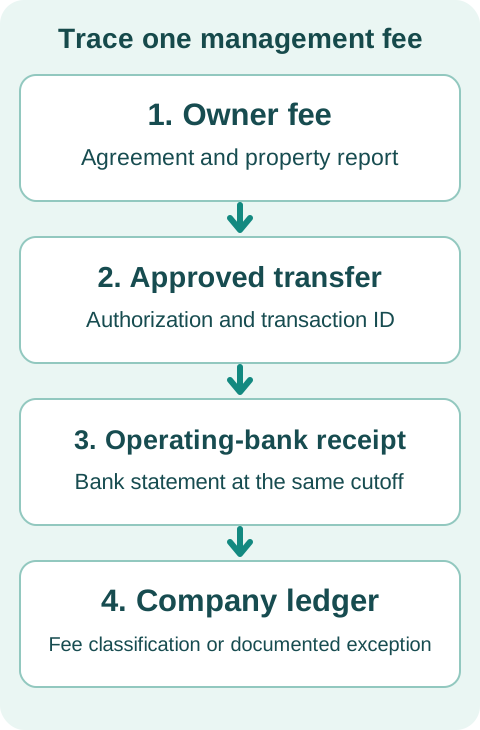
A useful test is to take one month’s fee total from the property report and trace it to authorized transfer detail, the operating-bank statement and the company ledger. Then take one refund or reversed fee and show how it changes both sides without a duplicate expense or income entry. Ask the provider to preserve transaction IDs, approvals and the original posting history so another reviewer can reproduce the answer.
What should the monthly review packet contain?
Request a defined packet and delivery date: owner/property fee detail, applicable management agreements or fee schedule, approved adjustment and transfer log, operating-bank reconciliation, company income detail, a fee bridge, open exceptions and reviewer sign-off. Trust-bank and beneficiary reconciliation are separate controls; include them in the scope where relevant, and use the existing three-way tie-out guide for that specific cash test.
The bookkeeper should explain what remains unresolved before owner statements or company reports are treated as final. A useful exception line identifies the property or owner, fee or transaction ID, amount, cutoff, source document, likely cause, person assigned, next action and decision on whether the related report or payment is held. The responsible manager or broker retains its approval and legal duties. State trust-fund rules vary; California’s DRE guidance is an example of why earned fees and trust money must be distinguished, not a nationwide rulebook.
What should you ask a prospective bookkeeping provider?
Ask for a short demonstration using fictional or properly redacted records. The answer should identify the two reporting views, trace one management fee end to end, distinguish a pending transfer from an unsupported one and name the reviewer. Software familiarity is helpful, but an auditable handoff is the better buying test.
Five questions for the provider
- Which owner and company reports will you deliver at the same cutoff?
- Can you trace one management fee from the agreement to both reporting views?
- Who resolves a transfer that was approved but is absent from the bank?
- Who reviews corrections and who alone may approve a payment?
- What historical cleanup is separate from the recurring monthly scope?
If the prior month cannot be reproduced, price historical cleanup separately from recurring work. Ask where the first reliable opening balance comes from, who resolves old exceptions, and when the monthly scope begins. Compare a monthly service with dedicated capacity only after you know the transaction volume, response schedule and review work; neither model automatically includes an audit, legal compliance opinion or unlimited daily coverage.
When is Daxable a fit for this scope?
Daxable can discuss property-management bookkeeping that connects agreed owner/property reports with the management company’s operating books and a reviewable reconciliation process. Bring a redacted owner statement, a company income report, the last completed bank reconciliations, your systems and one fee you cannot trace. A proposal should specify the accounts, periods, reports, review cadence, access, exceptions, cleanup needs and exclusions before work begins.
Daxable provides scoped bookkeeping and management-use reporting, not CPA attestation, tax or legal advice, a software-vendor certification, or a guarantee that every state trust requirement is met. Keep payment approval and regulatory responsibility with the authorized people in your business. The practical next step is to ask Daxable and other providers for the same fee-bridge deliverable and compare the evidence they can actually produce.
Sources
- AppFolio — accounting and reporting features, including owner statements and corporate accounting
- Buildium — property-management accounting basics and the owner-statement/company-P&L distinction
- California Department of Real Estate — Trust Funds guide (state-specific example)
- Google Search Central — guidance for helpful content and generative search features
Frequently Asked Questions
Can one bookkeeper handle a property-management company’s books and owner statements?
Yes, if the written scope names both reporting views, the system of record for each, a fee bridge, bank and ledger checks, reviewer and payment approver. One person preparing both views does not replace independent review.
Are owner statements the same as the management company’s profit-and-loss report?
No. An owner statement summarizes activity attributable to an owner or property; the company P&L reports the manager’s own revenue and expenses. Management fees connect the views, but the reports answer different questions.
What should happen when a management fee appears on an owner statement but not in the company bank?
Trace the fee to the agreement, authorized transfer, transaction ID and later bank activity. Record any unresolved difference with a responsible person and next step; do not assume it is a loss or force a balancing entry.
Should all tenant rent be recorded as company revenue?
No. Rent held for an owner is not automatically the management company’s revenue. The books should distinguish owner funds from the company’s earned fees using the client’s agreements and adviser-approved accounting policy.
Do AppFolio or other platforms eliminate the need for a fee bridge?
No software feature by itself establishes that the owner report, approved transfer, operating bank and company ledger agree. Confirm the configured reports and controls in your own account; Daxable does not claim a vendor partnership or universal integration.
What should I bring to a Daxable property-management bookkeeping call?
Bring a redacted owner statement, management-company income report, the last reconciled month, your system list and one fee or transfer you cannot explain. Share sensitive records only through an agreed secure process after scope and access are established.
Does a monthly bookkeeping fee include old trust or company-book cleanup?
Do not assume so. Ask for a separate assessment of unreliable opening balances or prior periods, with defined records, deliverables and review milestones before recurring work begins.