When you hire a bookkeeper after buying a rental property, agree on a purchase setup package before the recurring monthly work begins. Ask for the final settlement statement mapped to the books, a cash reconciliation that includes the earlier deposit, supported opening loan and property balances, and a list of questions for your CPA. A bank-feed entry for the closing wire is only one part of that job.
I would ask for the purchase reconciliation before judging the first monthly profit report. If the opening deposit or loan is wrong, a polished report can carry that error forward.
Scope the purchase setup separately from monthly bookkeeping
Tell the provider whether this is a new purchase, a takeover of existing books, or a correction to a purchase already recorded. Ask which entity and property its work covers, which date the opening schedules will use, and whether the earlier deposit is already in your ledger. Those answers prevent two people from recording the same transaction.
A useful written scope names the inputs, the person who prepares the entry, the reviewer, and the evidence returned to you. Ask whether the quoted work includes tracing a deposit paid before closing, investigating seller credits, and following up on corrected closing documents. Do not assume a monthly transaction allowance includes reconstructing the acquisition.
Before the review, gather the final settlement statement and any corrections, purchase agreement, deposit receipt, closing wire confirmation, bank statement, signed loan documents, and available rent or tenant-deposit transfer records.
How to agree on the opening-books handoff
Four steps to agree before accepting the setup
Name the property, entity and record set
Give the provider a property identifier and the legal buyer shown on the final documents. Identify the bank accounts that funded the purchase and the ledger in which the deposit was recorded. Note any payments made outside that ledger.
Check: The proposed scope states the buyer, property, cutoff date and missing documents; no assumed ownership or unexplained funding remains hidden.
Reconcile funding before coding the costs
Ask for a schedule connecting the deposit, final wire, loan funding, seller credits and refunds to the final settlement statement. Each cash amount should point to its bank evidence; each noncash credit should point to the closing record.
Check: Every funding line is accounted for once. A balancing total is accompanied by identifiable documents, not a plug to an expense or equity account.
Separate settled balances from CPA decisions
Ask the bookkeeper to list the proposed property, financing, prepaid, escrow and other balances, with the source for each. Identify which classifications or allocations need the CPA to decide under the applicable accounting and tax treatment.
Check: You receive a line-level schedule and an open-question list. Unapproved allocations are visibly provisional rather than presented as final tax conclusions.
Check the handoff into the next month
Agree how the opening loan will connect to the first lender statement, how the prior deposit clears, and how rent or tenant deposits transferred at closing will connect to the operating records. Name who investigates later refunds or corrected documents.
Check: The starting schedules reconcile to the posted ledger, and each unresolved item has an owner and next action before recurring reporting starts.
Worked example: the closing wire is not the purchase price
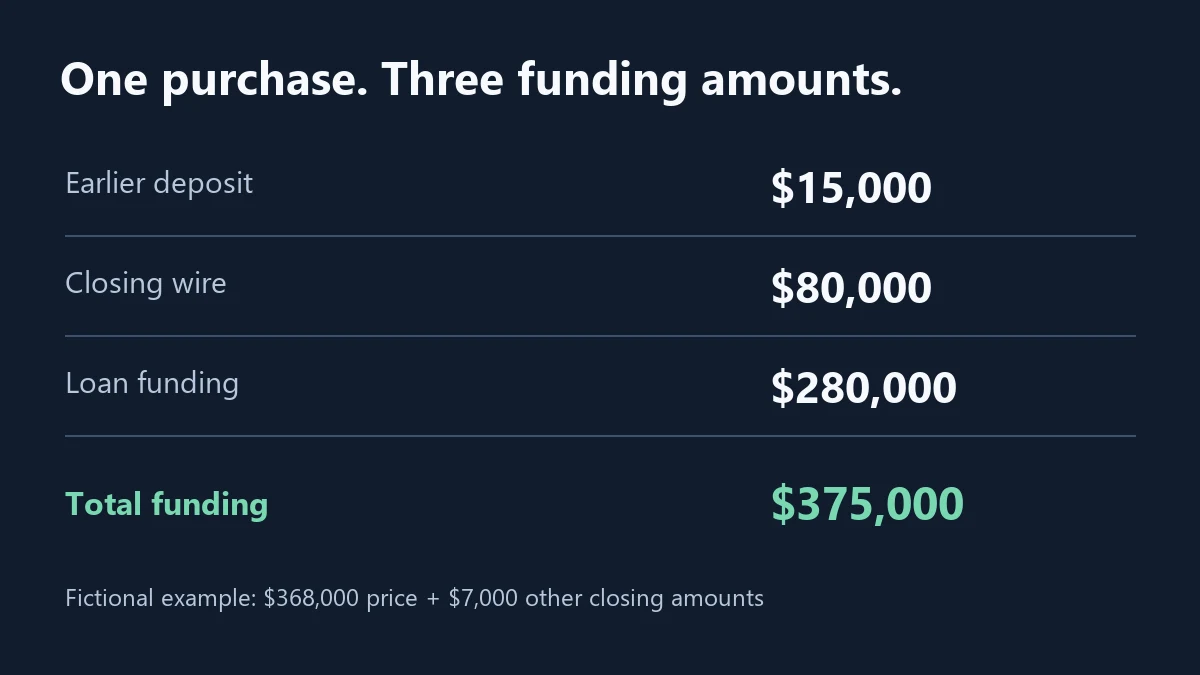
This fictional example assumes a $368,000 rental purchase and $7,000 of other closing amounts, with no seller credits, prorations, tenant deposits, refunds or other adjustments. A $280,000 loan funds part of the total. The investor paid a $15,000 deposit earlier and sends an $80,000 wire at closing. All cash payments come from the purchasing entity's bank account; the deposit is already recorded as an asset in that entity's books.
Scroll horizontally to read every column.
| Funding source | Amount | Evidence to match |
|---|---|---|
| Deposit paid before closing | $15,000 | Earlier bank payment, deposit receipt and credit on final statement |
| Wire paid at closing | $80,000 | Closing wire and bank statement |
| Loan funding | $280,000 | Final closing record and signed loan documents |
| Total funding | $375,000 | $368,000 purchase price plus $7,000 other closing amounts |
The entity paid $95,000 in cash across two dates. Only $80,000 left the bank on closing day. The $280,000 loan funded the rest.
Ask the candidate: “My earlier $15,000 deposit is already in the books. Show me how your setup uses it without recording a second payment.” A satisfactory explanation identifies the existing deposit balance, clears it through the acquisition entry, and matches only the new $80,000 wire to closing-day bank activity. The exact entry depends on how the existing ledger is configured.
Also ask where the $7,000 goes. The example deliberately does not supply an answer: it is an unspecified total of closing amounts, not one expense category. A provider needs the individual lines and the agreed accounting treatment. Getting to $375,000 proves the funding arithmetic; it does not prove that each account is correct.
Which decisions need more than the settlement total
IRS Publication 527 distinguishes settlement costs included in property basis from costs of obtaining a loan. It also treats land separately from depreciable buildings. Ask your CPA to determine the applicable allocations and treatment; ask your bookkeeper to retain the supporting decision with the schedules.
Do not supply a land percentage merely to make the file complete. Preserve the evidence used for the allocation and identify who approved it. Similarly, separate amounts held for future taxes or insurance from amounts actually paid at closing. The source documents and the applicable accounting treatment determine how those balances are recorded.
For an occupied property, request the rent roll, leases, transfer detail and amounts for prepaid rent or tenant deposits as applicable. Distinguish the cash received from the obligations taken over. Ask the provider to reconcile those records to the closing credits rather than treating every credit as rental income. Local deposit obligations and tax questions need the appropriate professional review.
What to request before signing off
The purchase-close acceptance packet
- Final closing documents and a list of any later corrections.
- A funding bridge showing deposits, the final wire, loan funding and applicable credits.
- A proposed or posted entry with source references and the treatment of amounts already recorded.
- Opening property, loan and other relevant schedules matched to the ledger.
- An exception list naming the unanswered question, needed evidence, responsible person and next action.
The handoff is ready when you can trace the purchase cash, identify the supported opening balances, and see who owns every unresolved item.
If the closing statement changes after posting, retain both versions, explain the difference, and agree who will update the books and supporting schedules.
A missing document need not prevent every supported part of the work from moving forward. Agree which balances can be posted, how provisional items will be labeled, and what remains excluded from final sign-off. Avoid accepting an unexplained adjustment solely because it makes the balance sheet balance.
During a discovery call, describe the purchase date, the entity, the software, and whether anything has already been recorded. Daxable can discuss the bookkeeping scope for your property records. Agree on the secure document-sharing method and any separate setup or cleanup work before sending financial records.
Prepared with AI assistance and source checks. The fictional example illustrates a review method; it is not a client result or evidence of personal testing or human review.
Sources
Frequently Asked Questions
Is the closing wire the amount recorded as the property?
No. The wire is one funding movement. The acquisition records also need to account for the earlier deposit, loan funding, credits and individual closing amounts. The property balance depends on the supported accounting treatment, not the wire alone.
Does monthly bookkeeping automatically include purchase setup?
The engagement determines that. Ask whether the quote includes the opening entry, funding reconciliation, supporting schedules, CPA questions and later corrections. Identify prior entries before approving additional setup work.
Should I give the bookkeeper only the closing statement?
Also provide the related bank evidence, earlier deposit records, loan documents and relevant transfer schedules through an agreed secure channel. The statement describes the closing; the other records help verify what was paid and what already appears in your books.
Can the books be finalized while a classification is unresolved?
Agree which supported balances can be recorded and which remain provisional. The exception list should identify the question, decision-maker and required evidence. Do not treat an unexplained balancing adjustment as a completed review.