Compare construction bookkeeping proposals by the work each person will perform, the records they need and the output you will receive. Ask specifically about job coding, billing, payroll allocation, WIP inputs, payment approval and unresolved items. A proposal should make those responsibilities visible before you grant access or compare fees.
These seven questions follow the work from transaction coding to month-end delivery. I would use the same active job and reporting cutoff with every provider, and compare who supplies inputs, completes each task and accepts the result.
Seven proposal questions
Seven questions for the scope discussion
Who will get each cost onto the correct job?
Ask whether the provider receives already coded transactions, assigns supported job and phase references, or also follows up with the field team when those references are missing. Those are three different workloads.
Best fit: field purchases and subcontractor bills arrive through several people.
Consider: a bookkeeper needs supporting information; a plausible job assignment is still a guess until it is supported.
Does billing support include preparing invoices or reconciling them?
List the tasks separately: maintaining approved contract and change-order records, preparing a draft invoice or payment application, obtaining approval, sending it, recording the receivable and following up on collection. Ask which tasks the fee covers and which remain with your office.
Best fit: an office administrator currently prepares draws or invoices.
Consider: a reconciled billing schedule does not establish that the provider will create, approve or send the next invoice.
Who supplies the labor information and checks the allocation?
Name the source of job-coded time, the payroll contact, the allocation method and the reviewer. Ask whether the provider allocates supported payroll to jobs or expects your payroll system to supply completed allocations. Specify who corrects time entries and which labor costs the allocation includes.
Best fit: crews move between jobs or time records arrive late.
Consider: bookkeeping support does not automatically include every payroll or compliance service.
What does the provider mean by WIP support?
Ask for the exact proposed output: reconciled historical inputs, a management-use work-in-progress schedule, a cost-to-finish forecast, or a package in the format requested by your CPA, lender or surety. Describe the reporting basis and review requirements before accepting a promise to “handle WIP.”
Best fit: jobs span periods or an external party requests a report.
Consider: preparing a schedule from supplied records is a different responsibility from estimating the remaining construction work or issuing an attest report.
How will the provider test the software handoff?
Ask the proposed provider to identify the setup work it will perform, the test record it will deliver and who will investigate failed transfers. Specify which implementation work is included in the engagement and which needs a separate quote. The existing QuickBooks and JobTread bookkeeping comparison explains the transaction checks to discuss.
Best fit: operations and accounting use separate systems.
Consider: a successful sync is evidence that records moved; it does not establish that every required record was supplied, coded and reviewed.
Which approvals and access will stay with your company?
Separate preparing a payment from authorizing its release. Name the people who approve new vendors, bank-detail changes, customer credits, unusual adjustments and payments. Ask how the provider receives those decisions and retains the supporting record.
Best fit: the provider will work with payables or collections.
Consider: access to perform bookkeeping is not a blanket instruction to move money or approve commercial decisions.
What must be delivered before you call the month complete?
Write down the expected financial statements, job reports, reconciliations, supporting schedules and open-item list. Specify the cutoff, source-record deadline, review contact and the process when an input is late. Ask who explains a margin movement or an unassigned cost after reports have been sent.
Best fit: competing proposals use similar phrases such as “monthly reports.”
Consider: an exported report can still contain missing inputs or unfinished checks.
Job coding and unresolved supplier bills
Intuit documents that project activity depends on assigning transactions to the project. Creating a project record gives the costs a place to go; someone still has to supply and check the assignment. Confirm that your actual subscription and workflow support the reports you expect.
Request one written example: a supplier bill arrives without a job number. Who contacts purchasing, who records the answer and who checks that the correction appears in the job report? Agree how unresolved costs are presented at the cutoff.
Billing schedules, deposits and retainage
Include customer deposits and retainage in that discussion when they apply. Identify who supplies release approvals and who explains differences between the billing schedule, receivables and receipts. Keep responsibility for contract interpretation and accounting policy with your authorized decision-makers and qualified advisers.
Payroll tasks outside the allocation
Keep payroll processing, tax filings, certified payroll, union reporting and employee classification as separate scope items. A proposal mentioning payroll reconciliation should explain which of those additional tasks, if any, it actually includes.
WIP inputs and accounting responsibilities
The project manager should have a named role in updating the operating assumptions: work remaining, expected purchases, subcontract balances and known changes. Identify who prepares the schedule, who reviews those estimates and who determines the applicable accounting treatment.
Daxable’s construction scope describes management-use WIP support using current project inputs, with accounting and tax treatment determined by the client’s CPA. Ask for the same clarity in any proposal.
Software handoff and transaction checks
JobTread documents a QuickBooks Online integration covering records such as invoices, bills and payments. That establishes an available software connection, not the scope of a particular bookkeeper’s engagement. Agree which person checks mappings, missing records, duplicates and timing differences in your setup.
Payment approval and vendor changes
Document user access and the handoff when a staff member or provider changes. Where your systems support separate users and permissions, agree access for the assigned duties and preserve the company’s control of its accounts. Resolve the workflow before granting broad access for convenience.
Opening cleanup and changes in scope
Assess opening cleanup separately. An ongoing monthly proposal should identify its starting point and any unresolved opening balances; it should also say how changes in job volume, systems or reporting needs affect the scope.
A worked scope comparison: six bills without job references
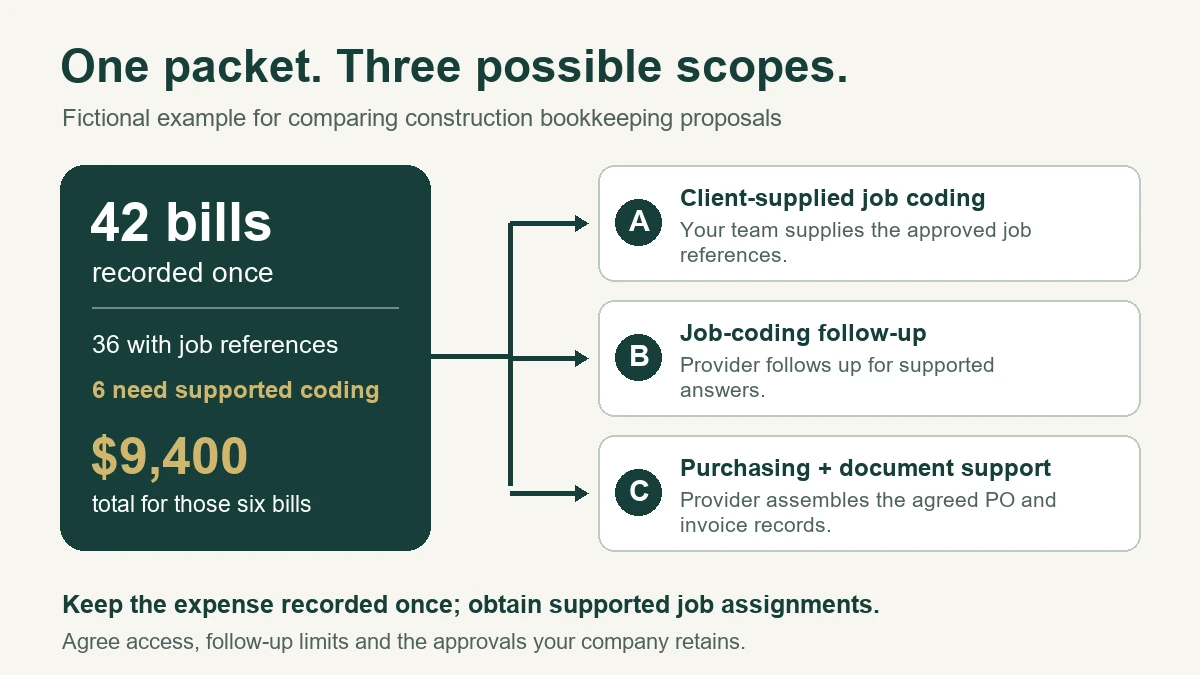
In this fictional example, a contractor supplies 42 bills for one closing period. Thirty-six have supported job references; six totaling $9,400 do not. Assume all 42 bills are already recorded in the company ledger; the unresolved question is job allocation.
The buyer asks three hypothetical providers how they would handle that same packet:
Scroll horizontally to read every column.
| Proposed arrangement | Included responsibility | Work the contractor must retain |
|---|---|---|
| A: company bookkeeping with client-supplied job coding | Reconcile the company books and report the six missing job references | Obtain the six answers and supply approved coding |
| B: bookkeeping plus job-coding follow-up | Track the six questions, follow up with named project contacts and apply supported answers within the agreed scope | Supply the underlying job information and approve ambiguous allocations |
| C: bookkeeping plus purchasing and document follow-up | Retrieve existing purchase orders, invoices and delivery records from agreed systems; assemble the support for the project manager’s decision, then complete the agreed bookkeeping follow-up | Approve ambiguous job assignments and retain commercial decisions; specify access, follow-up cadence and workload limits |
Choose the scope that covers the missing work. Keep approvals with authorized company staff, and agree access, follow-up frequency and workload limits.
Choose the responsibility you need covered
All three arrangements can be suitable. If office staff already assemble the supporting records but cannot consistently chase the six answers, B may cover the gap. If assembling those records is itself unstaffed, ask for a separate scope like C with agreed record access, follow-up cadence and limits. If your team supplies complete approved coding reliably, A may be enough.
The $9,400 is already in the company ledger in this illustration. It must remain visible as unresolved job allocation until supported; posting another $9,400 of expense would duplicate the recorded bills. Ask the provider to demonstrate the exception list, evidence trail and final job-to-ledger check, rather than merely promising a more detailed report.
Book a Daxable construction bookkeeping scope discussion, and bring one representative job, your current software list and the last reconciled period. Agree the work your team needs covered and the responsibilities it will retain. Historical cleanup and reconciliation can be assessed separately when the opening records need attention.
For the operating calendar after selection, read how to build a monthly construction close. For the relationship between recorded costs and remaining-work forecasts, read the construction job-costing guide.
Prepared with AI assistance. The worked example is fictional.
Sources
Frequently Asked Questions
Does construction bookkeeping always include job costing?
The proposal needs to define what is included: transaction coding, follow-up for missing references, job-to-ledger reconciliation, reports and review. Ask who performs each task and what your own team must supply.
Can a bookkeeper update the estimate to complete?
A bookkeeper can organize the agreed inputs and maintain a schedule, but the remaining-work estimate needs accountable operating input. Name the project person who updates and approves it, and have the qualified adviser determine the applicable accounting treatment.
Should a provider be allowed to release payments?
Agree payment authority separately from bookkeeping access. Identify the authorized approver, required evidence, release process and handling of vendor bank-detail changes before payment work begins.
How can I compare fees fairly?
Give each provider the same entity, account, job-volume, system, record-condition and reporting information. Compare included tasks, deadlines, client responsibilities, cleanup and separately priced work. A lower fee can fit well when your own team already covers the excluded tasks.