Property management bookkeeping services should turn receipts, bills and owner records into reconciled accounts and reports you can approve. Before I agree to a monthly fee, I want the proposal to name the work, the evidence delivered, the reviewer and the decisions my team retains. A useful scope tells everyone what “done” looks like.
A proposal that says “we handle your books” reminds me of a moving quote that says “we move your stuff.” I still want to know who is carrying the piano. In property management, that piano might be three unreconciled months or a stack of owner statements waiting for approval.
What should property management bookkeeping services include?
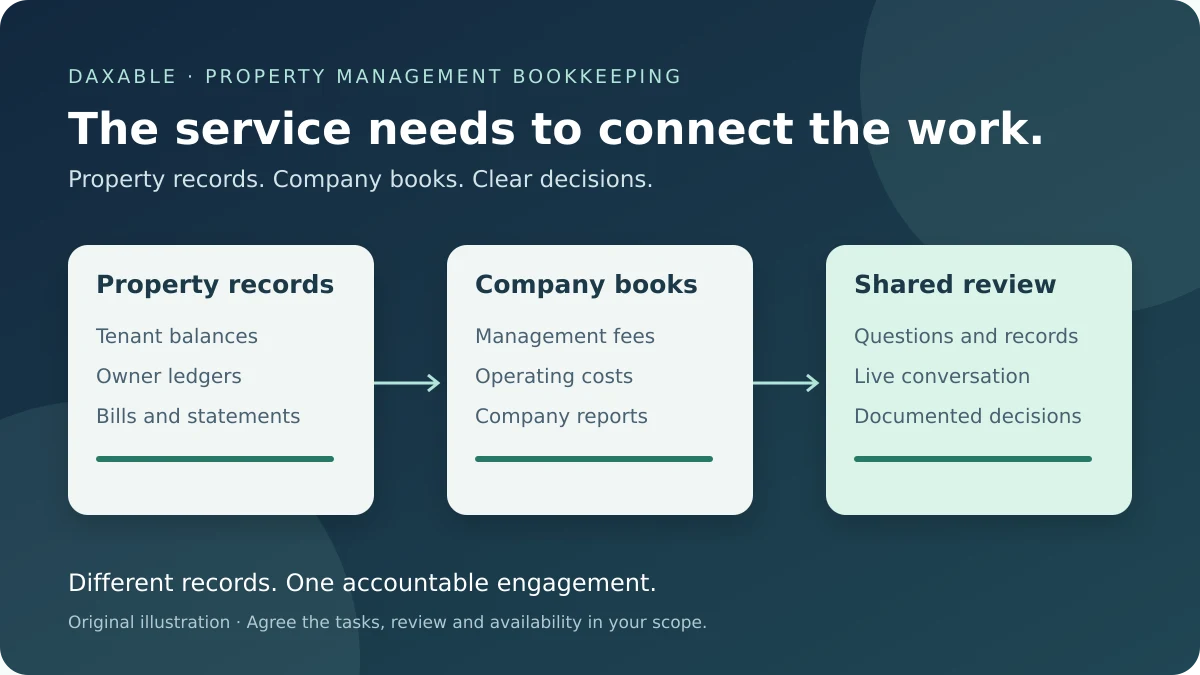
I would organize the scope around property records, the management company’s own books and the review that connects the work. Each task needs an output and a person who accepts it. “Monthly bookkeeping” is a starting description; the proposal should say which of these jobs you are actually buying.
Scroll horizontally to read every column.
| Work to assign | Delivery to request | Decision your team retains |
|---|---|---|
| Receipts and tenant activity | Posted receipts plus a list of unidentified, partial or reversed payments | Resolve missing lease or payment information |
| Vendor bills | Coded bills with invoices, property allocation and an approval queue | Authorize the expense and release payment |
| Bank and relevant trust records | Dated reconciliation reports, supporting ledger detail and explained differences | Review unresolved items under your agreed controls |
| Owner reporting | Draft statements and proposed distributions, with exceptions clearly identified | Approve statements and distributions before release |
| Management-company books | Agreed company reports and support for fees, overhead and transfers | Confirm accounting policies with the CPA or controller |
| Close and handoff | Final report packet, reviewer record and open-item list | Accept the delivery or return it for correction |
A provider may cover some or all of this work. Use the same worksheet for each quote, and identify every task left with your team.
Buildium’s published rental-accounting cycle covers charges, payments, deposits, bills, fees, owner statements and bank reconciliation. That is a useful inventory of work to discuss. Software documentation does not establish that a bookkeeping proposal includes every task.
What records do you need before requesting a quote?
Before requesting a quote, prepare an account and entity list, your software names, the last reconciled month, a redacted sample owner statement and a typical month of receipt and bill volumes. Add the management agreements, report deadlines and any known backlog. A provider needs that context to scope the work; share sensitive records only through an agreed secure process.
I would also identify who supplies missing invoices, answers tenant-allocation questions and approves a correction. A bookkeeper cannot infer a disputed lease term from a bank deposit. Your operations team needs a named part in the handoff, even when the posting work is outsourced.
How do you turn the work into a written scope?
Write the scope in the order the work will happen: define the records, agree the handoff, set the review calendar, assign authority and state how completion will be checked. The steps below produce a usable brief rather than a list of bookkeeping buzzwords.
Five steps to scope property management bookkeeping services
Name the books and the starting point
List each entity, property group and bank account. Name the system of record for property work and company work, the accounting basis agreed with your adviser, and the first recurring month. Identify prior periods that need assessment.
Check: You can point to every included account and period, and identify any opening balance still awaiting support.
Assign an input and output to each task
For every row in the worksheet, name who supplies the source record, who posts or prepares it, and what the reviewer receives. Include receipt reversals, missing bills and unanswered questions in an exception list.
Check: A sample receipt or invoice can be followed from its source to a posted record, review output and responsible person.
Agree a calendar with dependencies
Set the source-document cutoff, draft-report date, review window and final delivery date. Specify what happens when a bank statement or owner decision arrives late. Discuss posting frequency separately from the monthly close.
Check: Both sides can explain which delivery moves when an input is late, who is notified and who authorizes a revised date.
Separate preparation, review and release
Name the preparer, reviewer and authorized payment or statement releaser. Agree permissions, backup coverage, an escalation channel and the records retained when a correction is approved.
Check: A bill entered by the bookkeeper does not become an approved payment merely because it appears in the software.
Define acceptance and changes to the scope
List the final reports, reconciliation support and open items required for acceptance. State how new accounts, properties, extra reporting or historical cleanup are assessed and quoted. Agree how records and access are handed back if the engagement ends.
Check: The first close can be accepted against written evidence, and extra work has a defined approval path before it is charged.
These are the controls I would negotiate, not a universal service deadline. In a property-management discussion on Reddit, an accounting-team member asked which owner reports to send, how review works and whether closes should be staggered. Those questions are a good reminder to specify the calendar and reviewer. One discussion does not establish an industry standard.
What should a completed monthly delivery contain?
A completed delivery should contain the agreed final reports, reconciliations at a common cutoff, supporting ledger detail, a reviewer record and an exception list with an owner and next action for each unresolved item. I would accept the close only when the packet meets the written scope and any remaining limitations are explicit.
Use these as acceptance criteria in your proposal
- Reconciliation support identifies the accounts, cutoff, reconciling items and source statements used.
- Relevant owner, tenant and deposit records are included in the agreed population; trust totals are supported where that work is in scope.
- Draft and final owner reports are distinguishable, with review comments and approved corrections retained.
- Company reports use the agreed accounting basis and identify any fee or transfer differences requiring follow-up.
- The open-item list states the amount, affected record, missing evidence, responsible person and next review date.
- The delivery states what was completed, what remains unresolved and which decisions still need client approval.
For trust work, define exactly which records are being reconciled. North Carolina’s Real Estate Commission describes reconciling the bank statement to the books and then to the property trial balance identifying whose money is held. Its guidance is a North Carolina example; your responsible broker and adviser should confirm the requirements for your own jurisdiction and account structure.
I would ask for enough support to retrace one item without asking the provider to reconstruct the entire month. An owner statement, a bank report and a company P&L answer different questions. The packet should explain their connections and leave a clear trail for your controller or CPA.
What happens when something changes before owner approval?
The scope should require a revised packet and a clear approval decision when new evidence changes a draft. Here is a fictional acceptance exercise, not a client result: one owner’s draft distribution is $18,400 after the agreed reserves and all other known obligations. Before approval, a $1,200 rent receipt is returned and a separate $700 approved bill is found to be missing from the draft. Assume both reductions affect this owner’s distributable cash for the same cutoff.
Scroll horizontally to read every column.
| Draft or correction | Amount | Evidence to request |
|---|---|---|
| Original proposed distribution | $18,400 | Draft statement and the assumptions used |
| Returned rent receipt | −$1,200 | Return notice and corrected tenant/payment record |
| Approved bill omitted from the draft | −$700 | Invoice, approval and correct property posting |
| Revised proposed distribution | $16,500 | Revised statement and reviewer decision |
$18,400 − $1,200 − $700 = $16,500 under these simplified assumptions. This is an acceptance exercise, not a complete legal distribution formula.
If the return, bill or ownership allocation cannot be supported, keep the affected distribution pending under your agreed approval process and escalate the missing evidence. Do not manufacture an adjustment to make a draft appear finished. Any actual distribution still needs the applicable reserve, contract and jurisdiction checks.
I would expect the provider to label the old statement as superseded, explain the $1,900 change and send the revised version to the named reviewer. That is a small, observable service promise you can put in a proposal. “We send monthly reports” leaves that handoff unanswered.
How should you compare the price of bookkeeping services?
Compare prices against the same written workload: accounts, transaction volume, properties and owners, posting frequency, reporting, review and communication. Door count is useful context, but it does not describe a backlog, a high bill volume or an extra set of company books. Ask what changes the quote and when you will be told.
Keep historical assessment and cleanup visible in the proposal. An r/Bookkeeping discussion about pricing a property-management backlog described several years of missing entries and unreconciled activity. It is an individual account, but the practical lesson is sound: a recurring monthly quote does not tell you what reconstruction work has been included.
I would request separate lines for initial assessment or cleanup, recurring work, software charges and optional work such as specialized commercial reporting or year-end support. Ask whether preparing information for your CPA is included and who performs any filing. Daxable’s general starting price should not be treated as a quote for every property-management workflow.
Will the service require Buildium, AppFolio or QuickBooks?
The scope should follow the records and reporting you need. Buildium publishes property and company accounting capabilities, and AppFolio publishes corporate accounting alongside its property-accounting tools. Those product descriptions do not establish which features or permissions are active in your subscription. Ask the provider to name the actual systems and handoff it will maintain.
If QuickBooks is your separate company ledger, name the person responsible for connecting fees, transfers and supporting reports to that ledger. If company books already live in the property platform, describe that arrangement instead. I would settle the ownership of the records before recommending another software subscription.
What should you send a bookkeeping provider next?
Send a short brief that a provider can respond to line by line. You can adapt this wording: “Please quote recurring bookkeeping for our listed entities, properties and accounts, starting with the agreed month. Identify the last reliable reconciliation, source-record cutoff, posting cadence, draft and final reports, reviewer, payment approver, exclusions, separate cleanup work and the evidence required to accept the first close.”
At Daxable, our confirmed Buildium work includes transaction posting, rent receipts, vendor bills, bank and trust reconciliation, and owner statements inside Buildium. The proposal sets the actual duties, cadence, access and review responsibilities. If you want help defining that work, bring your account list, last reconciled month and reporting calendar to a scope discussion.
My recommendation is to leave that conversation with something you can check: a named deliverable, a deadline that accounts for your inputs and a person who decides whether it is ready. That is a useful foundation for a recurring bookkeeping relationship.
Sources
Frequently Asked Questions
What is included in property management bookkeeping services?
The agreed scope can include receipt posting, tenant and owner records, vendor bills, bank and trust reconciliation, owner statements and management-company books. Ask the proposal to name the included accounts, outputs, cadence and review responsibilities. Payment release and historical cleanup need explicit treatment.
How do I compare two property-management bookkeeping quotes?
Give both providers the same account list, transaction volumes, reporting calendar and backlog description. Compare included outputs, review, communication, software charges and retained client tasks. Ask how new properties, additional accounts or cleanup change the price.
How often should the service post transactions?
Agree posting frequency around your operating needs and the provider’s scope. A monthly close does not by itself promise daily posting or immediate responses. Put document cutoffs, review windows and late-record handling in the proposal.
Who should approve a revised owner statement?
Name the reviewer and authorized releaser in the scope. When new evidence changes a draft, ask the preparer to explain the difference, retain the superseded version and obtain the required approval before release. Confirm applicable responsibilities with your broker and adviser.
Do property management bookkeeping services include tax returns?
Check the engagement. Bookkeeping can organize records and support a CPA’s review without including tax-return preparation, legal advice or an audit. Daxable is a bookkeeping provider; any separate tax or assurance work should have its own qualified provider and scope.
What confirms that the first monthly delivery is complete?
Use the written acceptance criteria: final reports, dated reconciliation support, agreed ledger detail, reviewer record and a clearly assigned open-item list. A report marked final should also disclose any unresolved limitations; the label alone does not establish completion.