A property management bookkeeping service should track rent, bills, tenant balances and owner funds in the property system, reconcile the supporting records, and keep the management company’s books distinct. For a company managing other people’s property, I would favor demonstrated property-management experience, reachable communication and agreed review routines over a low quote or a long general bookkeeping résumé.
I am Saif Ahmed, founder of Daxable. I have more than 12 years of experience working with US real estate, construction and property-management businesses. My view is straightforward: I would hire a bookkeeper with three years of relevant property-management experience over someone with ten years of general bookkeeping experience, if the specialist can demonstrate the accounting, software and communication skills this portfolio needs. That is a preference about relevant competence, not a rule that three years guarantees quality.
What should a property management bookkeeping service actually cover?
Start with whose books you are asking someone to maintain. A third-party property manager holds and reports money for owners and tenants while running its own business. A landlord who owns the rentals has a different reporting relationship. A firm that only offers your management company a monthly profit-and-loss statement may be doing valuable work, but that does not establish that it is maintaining owner ledgers or reviewing tenant deposits.
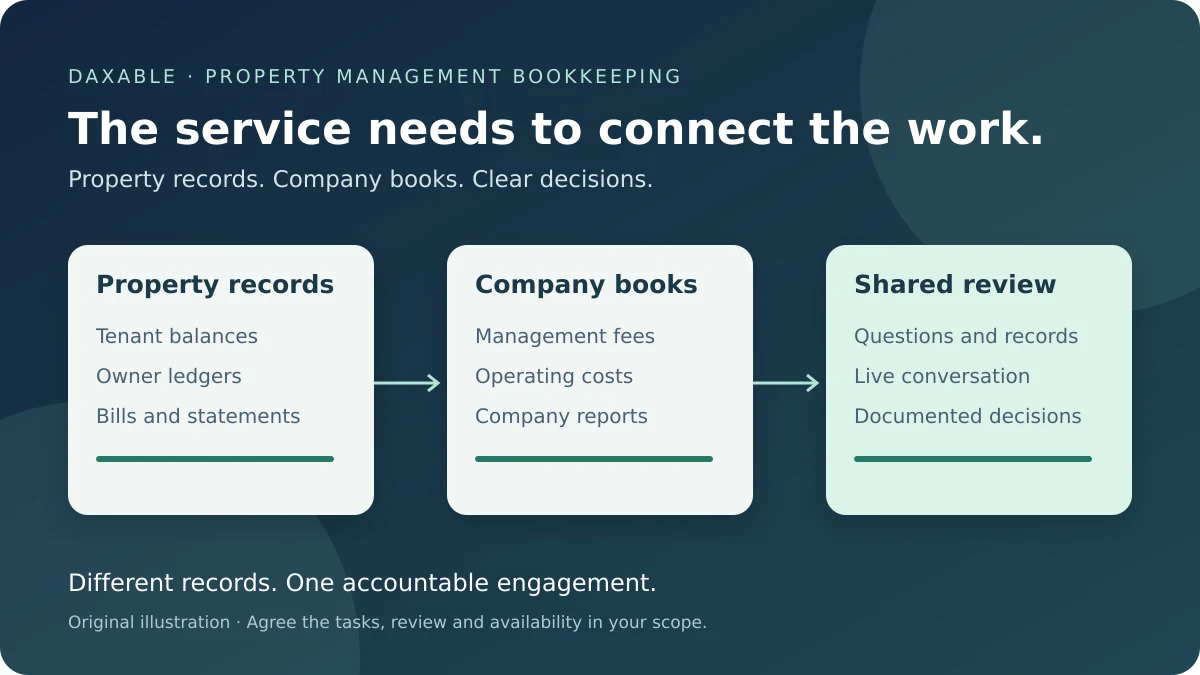
I would define the service in two connected parts. Property-level work covers receipt allocation, tenant and owner records, vendor bills, deposit liabilities where applicable, reconciliations, proposed distributions and owner statements. Company-level work covers the manager’s own fees, overhead, payroll records, operating accounts and financial reports. Include only the tasks you need, and write down the handoff between them. Neither set of books should be treated as a substitute for the other.
Buildium’s official accounting documentation distinguishes property and company financials. That is why I ask where the management-company work will live instead of assuming every property manager needs the same QuickBooks arrangement.
General bookkeeping firm vs property-management specialist: what changes?
This comparison evaluates two service models against the same ongoing-work requirements: reporting scope, money ownership, software, reconciliation, review, communication and engagement cost. The general model starts with business bookkeeping; the specialist model adds the portfolio-specific work agreed in the engagement. These are questions to verify with a provider, not claims that every general firm lacks a skill or that every specialist delivers it.
Scroll horizontally to read every column.
| Decision factor | General bookkeeping firm | Property-management specialist |
|---|---|---|
| Company books | A useful fit for categorization, account reconciliation and company reports within its agreed scope. | Confirm that company books are included; property bookkeeping alone may leave this work with you. |
| Owner and tenant records | Ask whether it accepts responsibility for the underlying property and tenant ledgers, rather than only a summary supplied to it. | Request property/owner allocations, tenant-balance review and deposit records as named deliverables. |
| Software | QuickBooks competence can support company books; verify additional property-platform work separately. | Demonstrate the required tasks inside your specific Buildium, AppFolio or Yardi product. |
| Reconciliation | Establish the accounts and reports it compares; a bank-to-ledger match is only the scope it proves. | For relevant trust work, define bank, cash-book and liability-ledger reconciliation at the same cutoff. |
| Owner reporting | Find out who prepares and checks owner statements if the firm receives only summary reports. | Identify the preparer, reviewer, unresolved items and approval before statements or distributions. |
| Communication | Agree a named contact, live escalation channel and response windows; broad services can offer these too. | Expect the same written commitments plus someone who understands the property issue being escalated. |
| Weekly review | Useful when the provider owns an active exception list; do not assume a monthly package includes it. | Specify a weekly agenda for unresolved receipts, bills, balances and upcoming owner reporting. |
| Price and accountability | Compare the quote with the tasks retained by your own team. | Compare the quote with the same tasks, cleanup boundaries, review and coverage; a specialist label is not evidence. |
A capable general firm can be right for company-only books. When the engagement includes owner funds, property ledgers and statements, I want demonstrated specialist capability and a clear review process.
A general bookkeeping firm can fit a company-only engagement when your property platform is already maintained and reviewed by a capable internal team. Its limitation is that a company-books engagement does not automatically include property-ledger, trust or owner-statement work.
A property-management specialist can fit an engagement that includes owner funds, tenant records and ongoing portfolio reporting. Its limitation is that the label alone proves nothing: you still need evidence of accounting judgment, platform competence, supervision and agreed availability.
For context, Intuit’s official general bookkeeping service describes transaction categorization, monthly reconciliation and company financial reports. It also offers access to people. I would not assume a general provider is email-only or automation-only; I would ask exactly which property tasks and contact arrangements it includes.
Why does the bookkeeper need more than QuickBooks knowledge?
Property management bookkeeping is not easy simply because transactions arrive through a bank feed. A rent receipt may need to be linked to a lease, tenant and property. A repair bill needs the correct property, supporting invoice and agreed authorization. An owner contribution, security deposit and management fee have different purposes. The person doing the work must understand the record behind the cash movement.
Proficiency with Buildium, AppFolio or Yardi is useful when it matches the system you actually use. AppFolio publishes accounting and reporting functions, including bank matching and corporate accounting. Yardi Breeze publishes payables, receivables, general-ledger and owner-statement features. Ask which product, tasks and access level the person has used; familiarity with one does not establish proficiency in another.
I would use a fictional example to check how the provider allocates a payment, investigates a bill, explains a reconciliation difference and prepares an owner statement. A screen demonstration should show both the accounting effect and the review path. Watching a tutorial or holding a QuickBooks credential can support learning; neither replaces demonstrated work in your portfolio.
Why can balanced books still contain a property error?
A total can agree while an amount belongs to the wrong owner. That is the distinction I want the service to understand. A three-way reconciliation compares the adjusted bank balance, the cash records and the total of the relevant liability or owner/property ledgers at one cutoff. Reviewing individual ledgers and supporting documents is still necessary even when the three totals agree.
North Carolina’s Real Estate Commission describes this reconciliation and retained broker responsibility in its trust-account guidance. This is a jurisdiction-specific example, not a statement that every state has identical account structures, deadlines or legal duties. Confirm the requirements for your business with the responsible broker and qualified adviser.
Here is a fictional service-review exercise, not a client case. There are two owners and no other balances or reconciling items. The adjusted bank balance, cash book and recorded owner-ledger total each equal $10,000. An authorized, correctly recorded $600 repair for Owner A has instead been allocated to Owner B’s property; the supporting work order establishes that the repair belongs to A.
Scroll horizontally to read every column.
| Record at the common cutoff | Recorded amount | Supported allocation |
|---|---|---|
| Owner A ledger | $7,000 | $6,400 after allocating A’s $600 repair correctly |
| Owner B ledger | $3,000 | $3,600 after removing the wrongly allocated $600 charge |
| Owner-ledger total | $10,000 | $10,000 |
| Adjusted bank and cash book | $10,000 each | $10,000 each; the allocation correction does not move cash |
The $600 changes which owner holds the balance, without changing total cash. Equal totals do not prove that each underlying allocation is correct.
I would ask the bookkeeper to compare the invoice, property address, work order, vendor and approval before recommending a correction. Then I would expect the reviewer to check the affected reports and payment proposals under the agreed process. Do not create an extra cash transaction just to correct the ownership allocation, and do not treat an owner statement as approved because a total balances.
What are property owners and practitioners worried about?
One public Reddit discussion describes an investor’s concern that outsourcing could leave them spending more time explaining transactions and correcting mistakes. The examples include duplicate repair charges and deposit-return questions on property-manager statements. These are self-reported experiences from one discussion, not a survey or evidence that all providers make those mistakes.
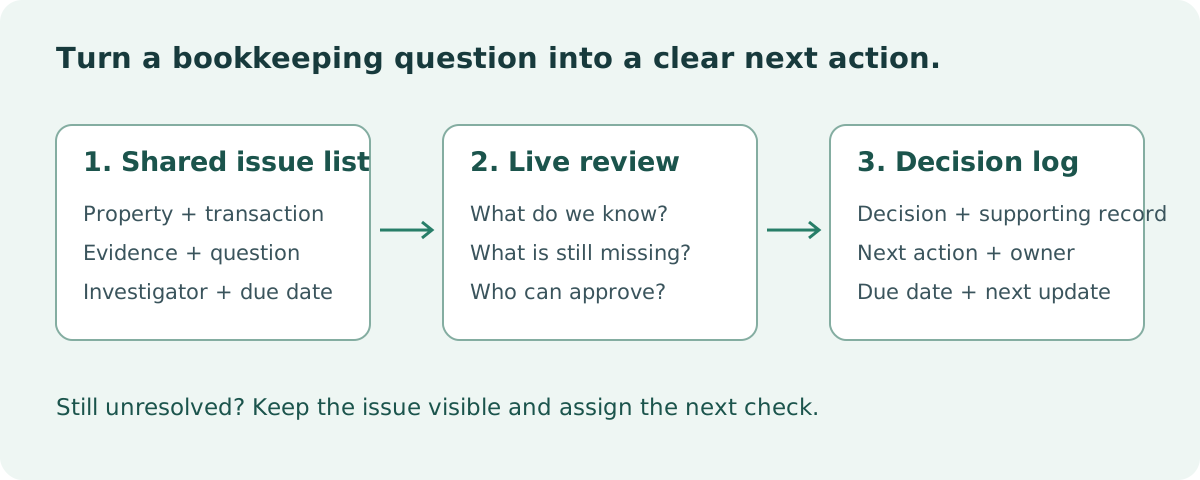
My response is to make the investigation process part of the engagement. A potential duplicate bill goes on a shared issue list with both invoice references, the property, the amount, the person investigating and the next update. The bookkeeper needs a route to the property manager or vendor records, not an expectation that the business owner will reconstruct every exception from memory. You retain approval and oversight; a service should make that oversight more organized.
What do YouTube practitioners add to the discussion?
In a video interview hosted by Pete Neubig, Mohamed Hussein discusses accounting becoming an afterthought as a property-management business grows, and the difference between general accounting software and a property system. The publisher provides a readable transcript of the discussion. The useful service-selection question is whether the provider understands both the operating records and the accounting they produce.
APM Help’s published transcript of its Buildium setup video also discusses accounting basis, payment allocation, management-fee settings and user permissions. This is provider-produced training, not independent endorsement of any service. I take it as a reminder to ask which settings affect your reports and who is allowed to change them, rather than assume a bank feed fixes the setup.
Creator opinions and older demonstrations can suggest questions; current official documentation, your agreements and actual records establish the facts for your engagement. I would not use a video’s broad claim about state compliance, insurance or software controls as a universal guarantee. Nor would I hand someone live payment authority merely because they can follow a tutorial.
Why do I want live communication and a weekly meeting?
If communication only happens through email, that would not be enough for the service I would choose for an active property-management company. Email is useful for records and approvals. But when an owner statement is due and a balance is unclear, you need a practical way to speak with the person responsible, work through the issue and document the decision afterward.
On-demand availability should mean an agreed live channel, working hours, response window and backup contact. It should not be interpreted as unlimited 24-hour coverage. Ask what happens when the main bookkeeper is absent and how an urgent issue is acknowledged. A promised response time and a promised resolution time are different commitments; an issue can require an invoice or owner approval before it can be resolved.
I would put a weekly meeting into the scope, particularly during onboarding, cleanup and an active reporting cycle. The meeting should produce decisions and assigned actions, rather than a vague statement that the books are being worked on. Use the same shared issue list during the week, so the call does not start with everyone searching their inbox.
Scroll horizontally to read every column.
| Review area | Question to resolve | Output before the meeting ends |
|---|---|---|
| Receipts and tenant balances | Which payment, reversal or allocation needs supporting records? | Named investigator, required record and next update. |
| Vendor bills | Which invoice is missing, disputed, potentially duplicated or awaiting approval? | Property, invoice reference, approval owner and decision deadline. |
| Owner balances and distributions | Which proposed payment or statement is affected by an unresolved item? | Clear hold or next review step; authorized approver identified. |
| Reconciliation and close | What period is complete, and what remains unexplained? | Completed cutoff, open differences and report delivery date. |
| Coverage and follow-through | What is due before we speak again, and who is reachable? | Owner, due date, live contact and written decision notes. |
The value is the resolved question and documented next step. Meeting frequency does not replace reconciliation or responsible payment approval.
How should you compare prices and outsourced providers?
The cheapest quote can be reasonable if it includes the work you need. It can also leave your team with software entry, invoice questions or owner reporting that you assumed was covered. I would compare written deliverables, transaction volume, bank accounts, owners/entities, backlog, software, review and contact arrangements before comparing the price.
For a simple fictional cost exercise, suppose a service costs $400 a month and the owner still spends four hours chasing or correcting bookkeeping work. If that owner values their time at an assumed $75 per hour, the combined comparison cost is $400 + (4 × $75) = $700. This is not a market quote, measured saving or claim about a competitor. It shows why retained work belongs in the decision.
Outsourcing itself is not the problem. A remote specialist can fit very well when relevant experience, software competence, supervision and communication are agreed. An in-house generalist can still need property training. Ask who will actually maintain your account, who reviews it, how the handover works and which questions they will resolve directly. Location alone tells you little about those answers.
Keep historical cleanup distinct from ongoing bookkeeping. Ask for the last reconciled cutoff, missing source documents, the repair plan, first-month outputs and the point at which routine work starts. If a prior-period issue is unresolved, it needs an owner and a plan; it should not disappear into a monthly promise.
Which service would I choose for a property-management company?
Choose the general model when your need is company books and a capable team already owns the property records. Choose demonstrated specialist capability when the service will maintain owner funds, tenant ledgers and portfolio reporting. If a general firm can demonstrate that capability, assess it on the same evidence. I would not pay for a label or dismiss a good provider because of its location.
At Daxable, I start the conversation with your actual software, the last reconciled period, owner reporting, unresolved work and how you need to communicate. We can scope property-management bookkeeping around those needs. Confirm the software tasks, company-book coverage, weekly review and live availability in the engagement before relying on them; this article is my selection approach, not a promise that every arrangement has identical coverage.
Daxable’s published service includes direct bookkeeping inside Buildium. AppFolio support is scoped around client-provided reports and exports alongside company books; Yardi work requires discovery of the actual product, available records and assigned person’s experience. We are independent of these software vendors and do not claim their certification or partner status.
My recommendation is to choose demonstrated property-management capability when the engagement includes owner and tenant records, and agree the reporting, review and communication deliverables in writing. Years of experience matter when they are relevant to the work. I want a bookkeeper who understands what the transaction means, can explain an exception and is reachable when the operation needs an answer.
Sources
- Buildium: property and company accounting
- Buildium: scalable property-management bookkeeping
- AppFolio: accounting and reporting
- Yardi Breeze: accounting and owner tools
- NCREC: trust-account reconciliation (North Carolina guidance)
- Reddit: outsourcing rental bookkeeping (self-reported discussion)
- Pete Neubig video interview with Mohamed Hussein (publisher transcript used)
- APM Help Buildium setup video (publisher transcript used)
Frequently Asked Questions
What does a property management bookkeeping service do?
It can maintain rent receipts, tenant and owner records, vendor bills, reconciliations and owner statements within an agreed scope. Confirm separately who handles the management company’s own books, reviews exceptions and approves payments. The scope and applicable trust requirements depend on your portfolio and jurisdiction.
Is QuickBooks knowledge enough for property management bookkeeping?
QuickBooks knowledge can support company bookkeeping, but it does not demonstrate proficiency in your property platform or understanding of owner and tenant records. Ask the provider to explain and demonstrate the required tasks in your actual Buildium, AppFolio or Yardi product.
Would you choose three years of specialist experience over ten years of general experience?
I would favor the three-year specialist if they demonstrate the accounting, software and communication skills this portfolio requires. Relevant experience matters more to my decision than the number alone. I would still verify their work, references and review process.
Should I meet my property-management bookkeeper every week?
I recommend a weekly review for an active engagement, especially during onboarding or cleanup. Cover unresolved receipts, bills, owner balances, reconciliation and upcoming reports. Agree the schedule and outputs in writing; a meeting does not replace daily escalation or payment approval.
Can I outsource property management bookkeeping?
Yes, if the provider has demonstrated relevant competence and you agree software tasks, access, deliverables, review, availability and escalation. Remote work does not remove your need for oversight. Keep payment approval and the responsible broker’s duties clear.
Does a three-way reconciliation prove every owner balance is correct?
No. Matching the adjusted bank, cash-book and ledger totals is an important control, but a wrong allocation can leave those totals unchanged. Review individual owner/property ledgers and supporting documents as well as the totals.
How much should a property management bookkeeping service cost?
Compare quotes for the same software work, volume, bank accounts, owners/entities, cleanup, review and contact arrangements. Include the work your team retains. There is no universal price that establishes the right scope or quality for every portfolio.