Hire a property-management bookkeeper who understands your portfolio, can work inside your actual software, has a repeatable review process, and communicates clearly. Ten years of general bookkeeping experience is a useful foundation, but I would still ask them to demonstrate those four things before handing over the books.
I have worked with property-management clients ranging from five doors to 5,000 doors. That experience has taught me to ask what a person can handle in this business, rather than stop at how long they have been a bookkeeper. The daily work, exceptions and review requirements can look very different as a portfolio grows.
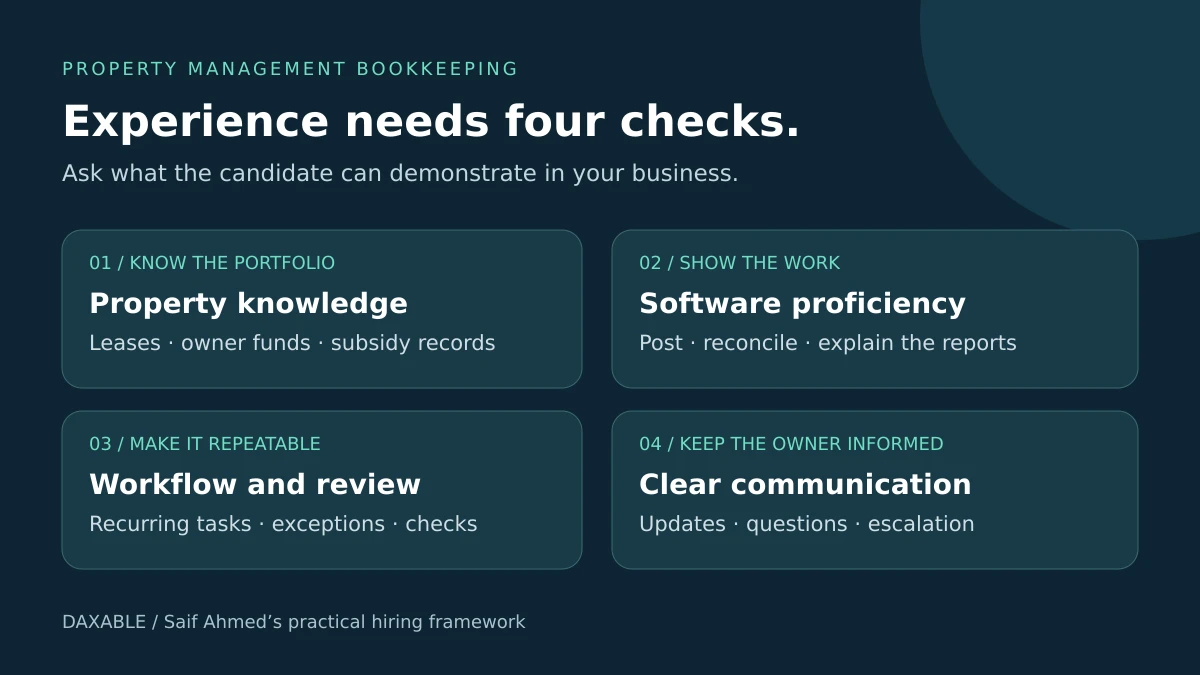
Why can an experienced bookkeeper struggle with property management?
A lot of owners think, “I will hire someone with ten years of experience, and the books should be fixed.” I understand why. Debits and credits, reconciliation and accounting principles matter. But property management asks the bookkeeper to apply those foundations to leases, tenant balances, reimbursements, owner funds and management agreements.
There are two separate gaps I would look for. Someone may know general accounting without understanding property management. Someone else may understand rentals but struggle to perform the accounting inside Buildium. You need to check both.
In a recent conversation, a prospective client told me their 2025 books were behind. One concern I wanted to investigate was whether the bookkeeper could actually do the work in Buildium. I had not established the cause. The lesson for hiring is to verify the software skill instead of assuming experience elsewhere will transfer.
What should you look for beyond years of experience?
Use the same criteria for every candidate, including Daxable. The table describes evidence I would request; it does not claim that every general bookkeeper lacks these skills or that every specialist has them.
Scroll horizontally to read every column.
| Hiring criterion | Claim to investigate | Evidence I would look for |
|---|---|---|
| Experience | Years of general bookkeeping | Examples of comparable property, lease and owner work |
| Software | Comfort with QuickBooks | Demonstrates the tasks inside your property platform |
| Affordable housing | Treats all rent as one payment | Explains the applicable tenant and subsidy records |
| Scale | Promises to enter everything manually | Explains recurring workflows and exception review |
| Quality | Says the bank balances | Explains ledger review and distribution checks |
| Communication | Says they are always available | Agrees updates, escalation and response windows |
| Credentials | Lists a certificate | Verifies its scope and shows practical competence |
A strong answer connects knowledge to actual work and a clear review process. A confident promise still needs evidence.
How should you assess a property-management bookkeeper step by step?
Before the interview, prepare a short portfolio brief: property types, doors, owners and entities, software, subsidy programs, the last reconciled month, and the reports you need. Use fictional or properly redacted examples for candidate exercises. Write down who approves payments and who handles unanswered questions.
Seven steps before you hand over the books
Describe the portfolio and the job you actually need done
Tell the candidate whether you manage properties for other owners, own the rentals yourself, or do both. Identify leases, reimbursements, deposits, distributions, company books and affordable-housing work within the role. Ask which parts they have personally handled.
Check: You can name the relevant experience, the tasks included and the gaps requiring training or a separate specialist.
Ask them to explain one property transaction from beginning to end
Use a fictional tenant payment, repair reimbursement or proposed owner distribution. Ask what documents they need, whose money it is, where they would record it and what could prevent the next step.
Check: Their explanation connects the lease or agreement, transaction, property or tenant ledger and resulting report; they ask about missing information.
Verify proficiency in your actual property-management software
Ask for a demonstration using fictional records or an authorized redacted work sample in Buildium, AppFolio, Yardi or the platform you use. Have them explain a rent receipt, vendor bill, reconciliation and owner statement.
Check: They can explain the accounting effect and review path, as well as locate the relevant screens or reports. QuickBooks familiarity is not used as a substitute.
Check how they organize recurring work and exceptions
Ask which charges, bills and reports can follow a recurring workflow, which need human review, and how failed payments or unclear allocations enter an exception list. Ask what changes when transaction volume grows.
Check: They describe a repeatable process with named responsibilities, supporting records and a route for unresolved items.
Agree on quality checks before reports and distributions
Ask who prepares the books, who reviews exceptions, and which balances and commitments are checked before a proposed distribution. Define who has authority to approve or release a payment.
Check: The candidate distinguishes preparing a number from approving a payment and can explain what would cause them to pause and escalate.
Test communication with a short written update
Ask the candidate to explain a fictional unresolved issue in plain English: what happened, what it affects, what they need from you and when they will update you. Agree on routine updates, urgent escalation and realistic response windows.
Check: The message makes the next action and owner clear. You have a named contact and an agreed way to resolve questions without chasing repeatedly.
Confirm the first-month deliverables and availability
Agree on a scoped opening-balance review, work schedule, reports, close dates and handoff responsibilities. Check references and claimed credentials. Establish what on-demand help means for your time zone and portfolio.
Check: The written scope identifies deliverables, deadlines, access, reviewers and coverage. Open historical issues have a separate resolution plan.
The interview is complete when you can explain who will do the work, what they have demonstrated, how issues will be reviewed, and how you will hear about progress. Any skill gap should have a named solution before the engagement starts.
If the candidate cannot explain a missing subsidy payment, an unclear owner balance or a software task, pause that part of the hiring decision. Ask for the missing records or a second demonstration. Do not give them unrestricted live access just to find out whether they can do the job.
What does affordable-housing knowledge add to the role?
If your portfolio includes affordable housing, match the candidate to the actual program. “I know rental bookkeeping” is too broad an answer. Ask what they would compare when a tenant payment arrives but an expected assistance payment does not.
For the Housing Choice Voucher program, often called Section 8, the housing assistance payment from the public housing agency and the tenant’s portion of rent are distinct. The HUD contract says the tenant is not responsible for the agency’s covered portion. I would ask the candidate to show how they would track the two portions and investigate a missing payment without automatically treating it as tenant arrears.
Other affordable-housing programs have their own requirements. Ask for relevant experience and the records needed for your portfolio; one example does not establish expertise in every program. Closing or HUD settlement statements are a different document category again. Where a property purchase or refinance is within the bookkeeping scope, ask how the final closing records support the entries.
When does software and workflow become more important than door count?
In my experience, a very small portfolio—roughly under 20 units—may be manageable with a thoughtfully organized general ledger and other operating tools. Around 50 units, I would look closely at the manual workload. At 100 or more, I would want a serious discussion about a dedicated property-management platform and repeatable processes.
Those are my practical review points, not technical QuickBooks unit limits. A smaller portfolio with several owners, entities or subsidy arrangements may already need more specialized workflows. A larger portfolio with simpler transactions may have different needs. Ask about transaction volume, reporting obligations and time spent correcting exceptions.
Buildium provides property accounting, bank reconciliation and connected payment workflows; AppFolio and Yardi also publish property accounting capabilities. A product name on a résumé does not prove the candidate can use those capabilities well. General-ledger knowledge still matters, and the person should explain how property records connect to company and CPA reporting.
I am not saying you need AI to scale. Start with sensible recurring processes, supported rules, a document cutoff and a way to review exceptions. Ask which tasks they would automate, what they would check afterward, and what they would keep under human review.
What should good communication sound like?
Communication is part of the work. If a bookkeeper cannot explain an unresolved balance, you cannot make an informed decision about it. I would rather receive a clear question with the records needed to resolve it than hear “everything is fine” while the issue remains open.
Ask for a routine update that covers completed work, unresolved questions, the next deadline and any decision needed from you. Agree what counts as urgent—such as an unclear balance before an owner distribution—and who receives that escalation. Availability should be defined around your business, not left as a vague promise to be on demand.
A short fictional writing exercise helps here. Give them an unresolved receipt and ask for a message to the owner. Does it identify the transaction and missing information? Does it explain the effect without blaming someone or using jargon? Does it name the next action? You are checking whether you can work together when the answer is not immediately obvious.
What is my recommendation before you hire?
I would look for a sound bookkeeping foundation, relevant property-management knowledge, hands-on proficiency in your platform, a review process that can grow with your workload, and dependable communication. A verified QuickBooks credential is useful evidence of training; it does not replace the other checks.
If you are considering Daxable, bring your software, portfolio details, last reconciled month and the questions you need answered. Daxable’s confirmed Buildium work includes transaction posting, rent receipts, vendor bills, trust and bank reconciliation, and owner statements inside Buildium. Agree the specific work, access, communication and review responsibilities in writing.
Sources
Frequently Asked Questions
Is ten years of bookkeeping experience enough for property management?
Years of experience help, but they do not establish property-management or software competence. Ask for comparable work, a demonstration in your platform, a review process and a clear written update. Assess the candidate against your actual portfolio.
Can a QuickBooks bookkeeper do the books in Buildium?
They may be able to, if they also understand property management and have practical Buildium proficiency. QuickBooks experience alone does not demonstrate the ability to post transactions, reconcile accounts and prepare owner reports inside Buildium.
What should I ask a bookkeeper about Section 8 rent?
Ask how they track the tenant’s rent portion separately from the housing agency’s assistance payment, support those amounts with current records, and investigate a missing payment. Match their experience to your specific affordable-housing program.
What communication should I expect from a property-management bookkeeper?
Agree on a named contact, routine progress updates, clear questions, escalation before important deadlines, and realistic response windows. The bookkeeper should explain what is unresolved, what it affects and what they need from you.
Does QuickBooks stop working above 50 rental units?
There is no 50-unit product limit established by this guide. My concern around that size is operational workload: manual allocations, owner reports and exceptions. Consider complexity and transaction volume when assessing whether dedicated property-management software would help.
Should a property-management bookkeeper be QuickBooks certified?
A verified QuickBooks credential can support their general accounting foundation. Also check property-management knowledge, experience in your actual platform and practical review skills. Certification by itself is not a complete hiring assessment.
What can Daxable do directly inside Buildium?
Daxable’s confirmed scope includes transaction posting, rent receipts, vendor bills, trust and bank reconciliation, and owner statements inside Buildium. Confirm the engagement’s deliverables, access, communication, review and approval responsibilities before work begins.