I would stop the Buildium-versus-QuickBooks debate long enough to ask who needs the numbers and what they need to decide. Buildium includes property and company accounting. QuickBooks can still be useful as a separate company ledger when the reporting workflow calls for it. Either way, operations, your CPA and your controller need a clear handoff at month-end.
A full rent roll can look reassuring. So can a healthy bank balance. Neither one tells me, by itself, whether the management company can afford another employee. That is where I want the conversation to go.
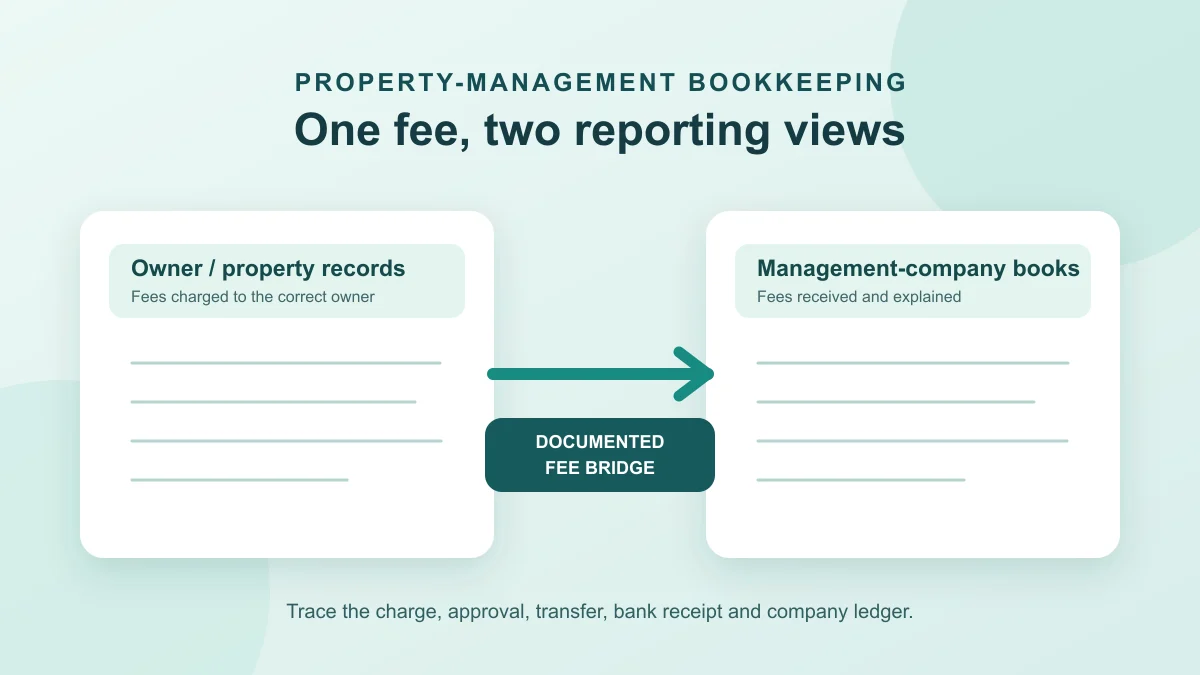
Why can everyone have a report and still disagree?
Imagine asking three people how the month went. Your property manager says collections improved. Your CPA wants the missing balance-sheet support. Your controller wants to know why revenue per door went up while cash got tighter. Those answers can all be reasonable.
I think of it like a restaurant. A full dining room, a balanced cash drawer and enough money for next week’s payroll are three different achievements. The manager needs to understand all three. Counting occupied tables will not settle the payroll question.
Scroll horizontally to read every column.
| Reader | Question | Useful handoff |
|---|---|---|
| Owner and operations | What needs attention in the portfolio? | Collections, open charges, maintenance commitments and owner-statement exceptions. |
| CPA | Are the entity’s records complete and supported? | Reconciled ledgers, balance-sheet schedules and unresolved accounting questions. |
| Controller or finance lead | Can we fund the plan? | Fee revenue, operating costs, cash timing and clearly defined KPIs. |
One agreed cutoff and documented definitions let the team explain differences instead of arguing about screenshots.
What does each system contribute to that meeting?
Buildium is not merely a tenant database. Its published features include property accounting, bank reconciliation and company financial reporting. I would give those capabilities a fair assessment before adding another general ledger.
Scroll horizontally to read every column.
| Decision | Buildium | QuickBooks Online |
|---|---|---|
| Property activity | Property records, resident payments, vendor bills and owner reporting. | General accounting records; property operating workflows need a defined supporting system. |
| Company books | Company financial reporting is available within Buildium. | A separate company ledger when that fits the agreed accounting and CPA workflow. |
| Month-end review | Review the property and company reports within the configured accounting structure. | Review company financials and reconcile any records handed over from the property system. |
| Best fit | A property manager who wants operating records and accounting together. | A management company with a defined need for a separate company accounting workflow. |
| Limitation to plan for | A complete platform still needs correct account setup, reconciliations and review. | A second ledger adds a handoff and does not automatically replace property-management controls. |
My recommendation: keep Buildium alone when it meets the agreed needs; add QuickBooks when a separate company ledger has a specific purpose and someone owns the handoff.
The deciding question is what the second ledger adds. A CPA’s workflow, company reporting requirements or the way other business activity is organized may justify it. “Everybody uses QuickBooks” is not a scope of work.
I cover the software-selection decision in more detail in the existing Buildium and QuickBooks guide. Here I want to concentrate on what your team does with the numbers after the software is chosen.
Whose money are we talking about?
For a third-party property manager, I would put that question ahead of any dashboard. Rent handled for clients and fees earned by the management company have different owners and different reporting purposes. Moving money between accounts does not, on its own, explain who earned it.
Consider a fictional management company whose property records show $10,000 of earned management fees for the month. An approved $500 fee credit reduces that to $9,500. By the cutoff, $9,000 has reached the company’s operating bank and $500 remains due. Assume accrual-basis company reporting, no opening fee receivable and no other adjustments.
Scroll horizontally to read every column.
| View | Amount | Question to resolve |
|---|---|---|
| Property fee detail | $10,000 fees − $500 credit = $9,500 net earned fees | Do the owner-level charges and credit have support? |
| Company ledger | $9,500 revenue; $500 still receivable | Does the company record the same net earned fee under the stated accrual assumptions? |
| Operating bank | $9,000 received | Can each receipt be traced to the approved fee transfer? |
$9,000 received plus $500 still due explains $9,500 earned. A different accounting basis requires a different presentation, not an unexplained plug.
That bridge gives all three people something useful. Operations can check the charges. The CPA can review the classification and support. The controller can see that part of the reported revenue has not yet become company cash.
I would not copy every tenant receipt into a QuickBooks company-income account just to make the two systems look synchronized. First establish the entity, the ownership of the funds and the records that actually belong in each ledger.
Where does three-way reconciliation belong?
There are two checks here, and I would give each its own line on the close checklist. A cross-system tie-out checks the relevant overlapping activity between the property records and the company books, then explains the cash movement. A three-way trust reconciliation checks the adjusted trust-bank balance, the trust cash ledger and the total of the applicable beneficiary or property ledgers at the same cutoff.
Those are not interchangeable. The North Carolina Real Estate Commission explains the bank–books–property-ledger comparison in its trust-account guidance. That is a state-specific reference; use the requirements that apply to your business. A separate QuickBooks subscription is not one of the three things being reconciled.
Even matching totals are not the end of the review. If a payment is allocated to the wrong owner, the overall cash can still balance. I would inspect the owner detail and investigate negative or unexplained balances before treating the close as finished.
What should reach the CPA and controller?
A Reddit user who moved their accounting from QuickBooks into Buildium asked how to organize the accounts for tax reporting. I would take that as a reminder to agree the reporting structure with the CPA before migration. It is one person’s question, not proof that Buildium cannot support tax preparation.
The monthly packet I would ask the team to share
- A cutoff date, entity list and accounting basis stated on the reports.
- Completed bank reconciliations and any required trust reconciliation, with supporting owner detail.
- A management-fee bridge, including credits, transfers and amounts still due.
- Company financials with supporting balance-sheet schedules and a list of open questions for the CPA.
- A forecast and KPI sheet that identifies assumptions, source reports and the person responsible for each follow-up.
For the controller, I would agree the KPI definitions as carefully as the chart of accounts. Does “revenue per door” use average managed doors or the number at month-end? Does “collection rate” mean cash against this month’s charges, or does it include old arrears? A trend is only useful if the calculation stays consistent.
What does connected bookkeeping look like in practice?
I want the work to move through a clear process: a vendor invoice arrives, someone reviews it, the approved record reaches the correct property, the payment is recorded, and the close reviewer can follow the trail. Gmail and calendar reminders can support that process when the available tools and permissions allow it.
I would verify the actual connector or export process before promising automation between Buildium and QuickBooks. A documented, reviewed handoff is more useful than an integration nobody can explain. The same goes for reminders: a calendar event helps only if someone owns the work behind it.
How can Daxable help?
At Daxable, we specialize in bookkeeping support for property managers using Buildium and AppFolio. Our Buildium work includes transaction posting, rent receipts, vendor bills, trust and bank reconciliation, and owner statements. For AppFolio, we scope the work around client-provided reports and exports and confirm access requirements before promising a setup.
We can help organize the bookkeeping setup, define the monthly handoff and coordinate the records your CPA and controller need. Bring your current owner statement, company reports and one unresolved difference. I would start there before recommending another software subscription.
This comparison uses published Buildium and Intuit information, the original Reddit question and the cited reconciliation guidance. It is a workflow assessment, not a test of your account. Subscription prices, setup effort, export or connector costs and ongoing review depend on the chosen scope; get those confirmed together before deciding.
Editorial note: prepared and fact-checked on October 26, 2026 for the October 14 archive entry.
Sources
Frequently Asked Questions
Do property managers always need Buildium and QuickBooks?
No. Buildium includes property and company accounting. Add QuickBooks when a separate company ledger solves a defined requirement and someone owns the transfer, reconciliation and review process.
Is a Buildium–QuickBooks tie-out a three-way trust reconciliation?
No. A cross-system tie-out checks corresponding records between systems. A three-way trust reconciliation compares adjusted trust-bank cash, the trust cash ledger and applicable beneficiary or property-ledger totals. Follow the requirements that apply to your business.
Does collected rent equal management-company revenue?
Rent collected for third-party owners is not automatically management-company revenue. Identify whose money it is and separately support the company’s earned fees and other income under the agreed accounting basis.
Can a company use one system and still serve all three reporting needs?
Yes, if the setup supports operations, complete accounting records and the required planning reports. Some planning work may use separate reporting tools. The number of subscriptions matters less than clear definitions, complete records and accountable review.